Geothermal
 Background
 Purpose
 Technology Introduction
 Projects and Goals
 Current Status and Latest Developments
 Get to Know the Team
 Project Milestones
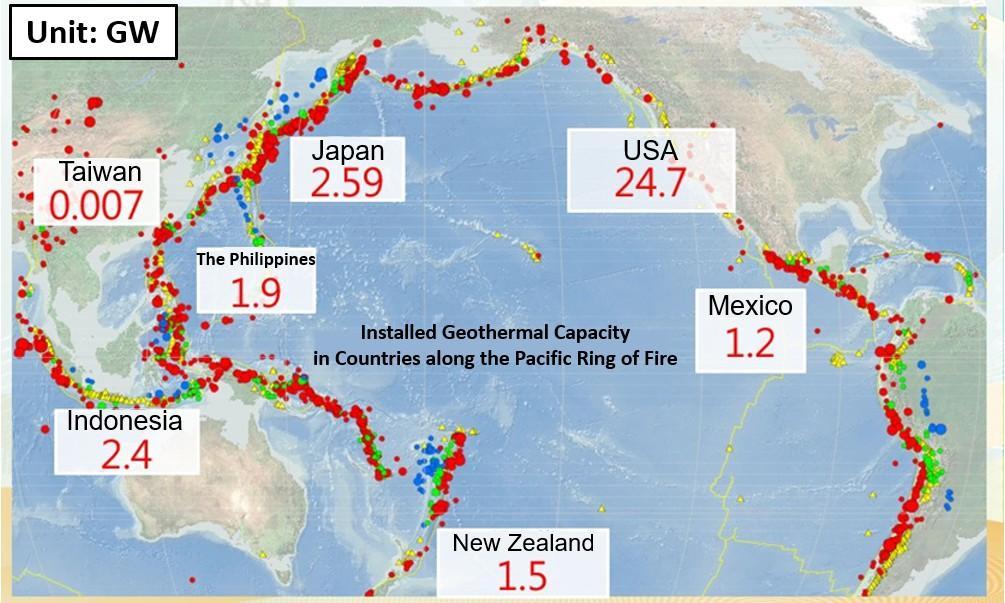
On the pathway to net-zero, geothermal resources have been considered as a renewable energy with high potential for development, especially in countries along the Pacific Ring of Fire, where geothermal resources are abundant. Currently, many nations in the region are working to develop geothermal resources (Figure 1), and some have reached GW-scale installed geothermal capacity. While the geothermal capacity in the U.S. has exceeded 20 GW, Taiwan has only 0.0007 GW, showing substantial room for improvement.
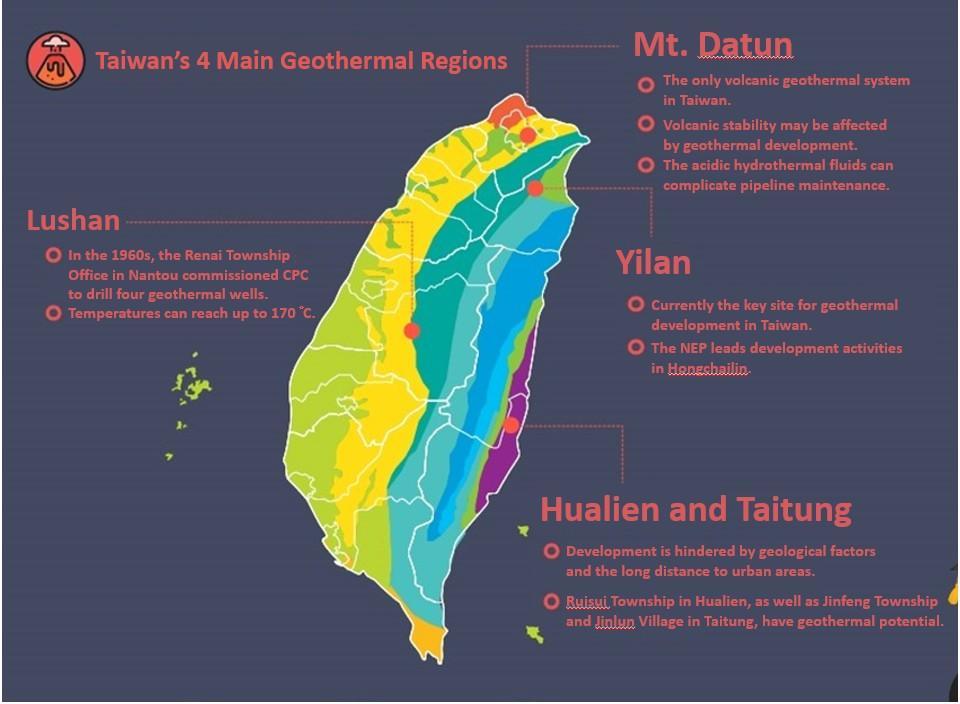
According to previous studies, Taiwan has four major regions of high geothermal potential (Figure 2) that could generate more than 30 GW of geothermal capacity[1]. In the four areas, deep geothermal resources at depths greater than 3 km account for over 95% of the potential capacity, while shallow geothermal resources contribute only around 1 GW. As a result, Taiwan must develop deep geothermal to achieve more than 1 GW of geothermal capacity. In the past, deep geothermal development has been costly, resulting in the absence of large-scale geothermal power plants worldwide and a corresponding lack of technical experience. However, in recent years, global demand for renewable energy has increased to meet the net-zero target, and some geothermal countries have shifted from shallow to deep geothermal development. Currently, at least 17 production wells worldwide have been drilled to depths over 3 km2. The Geysers in California, U.S., for instance, is the world’s largest geothermal power complex focusing on deep geothermal development.
Taiwan urgently needs stable, indigenous, zero-carbon baseload power. If developed efficiently, geothermal power can provide significant support on Taiwan’s pathway to net-zero. Therefore, Academia Sinica has been conducting environmental surveys and exploration works on deep geothermal to help the government identify suitable areas for geothermal development as quickly as possible.
Geothermal power generation technology encompasses geological surveying and exploration technologies as well as drilling and heat extraction technologies. Working with CPC Corporation, Academia Sinica hopes to make use of scientific research information from geological surveys to more precisely locate areas with high geothermal potential, thereby reducing the costs and risks associated with development. Additionally, the follow-up development team can conduct research and development on deep geothermal heat extraction technology.
Geological surveying and exploration technology for locating heat sources
Heat inside the Earth is an inexhaustible source of energy[3]. However, due to the limitations of current drilling and heat extraction technology[4], heat in the deep interior of the Earth is not yet accessible. At present, humans can only explore and utilize heat sources accumulated in geothermal reservoirs and crustal fractures within the depth range accessible to existing drilling technologies.
The crucial first step in geothermal development is locating heat sources. Development costs and risks can be reduced if both the location of heat sources and the type of geological structure are explored with higher precision. To achieve this, Academia Sinica’s research and development project conducts environmental surveys of geothermal resources using multiple advanced technologies, including magnetotellurics (MT), subsurface geological imaging, seismic tomography, seismic cross-sections, deep drilling, and UAV-based thermal sensing.
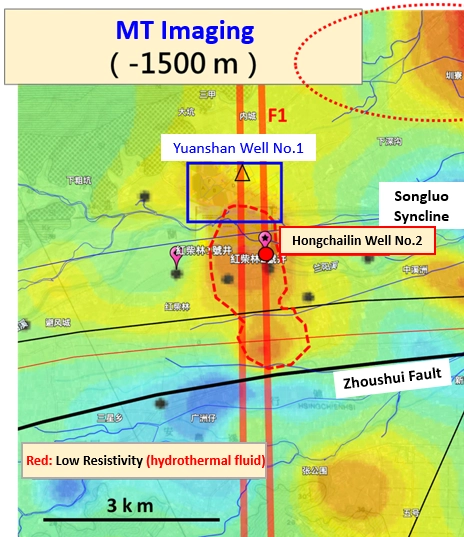
For example, MT is a geophysical survey method that measures the attenuations and phase shifts of electromagnetic waves generated after the waves interact with the variations of electric (resistivity and conductivity) and magnetic fields across different subsurface strata. According to the measurement, the resistivity distribution in each stratum can be estimated. Low resistivity zones indicate potential hot water reservoirs for geothermal development. Subsurface structures can be mapped based on this information (Figure 3).
Drilling and heat extraction technology for deep geothermal
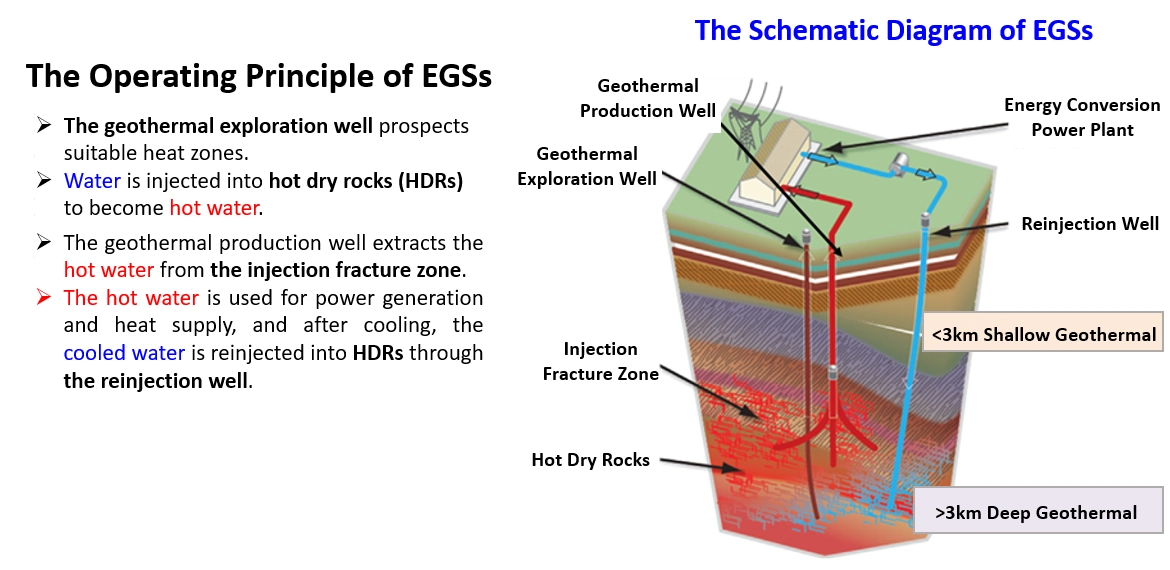
Conventional Geothermal Systems utilize groundwater heated by subsurface heat sources as a medium for heat transfer. The heated groundwater is extracted through geothermal wells and used to drive steam turbines for power generation. However, deep geothermal is located at depths greater than 3 km, and the rock formations known as hot dry rocks (HDRs) can reach temperatures of more than 150°C. Given the situation, Enhanced Geothermal Systems (EGSs), which have been implemented at a few demonstration sites, can be adopted. In EGSs, water is injected through the injection fracture zone above the HDRs. Once the water is heated, the resulting hot water or steam is extracted from the subsurface for direct use in power generation and heat supply. Afterwards, the hot water and steam are reinjected into the HDRs, creating a circulation system (Figure 4).