

Methane Pyrolysis to Power (MPTP)
 Background
 Purpose
 Technology Introduction
 Projects and Goals
 Current Status and Latest Developments
 Get to Know the Team
 Project Milestones
For a long time, thermal power generation has accounted for more than 80% of Taiwan\'s total power generation[1] , providing a stable power supply, yet at the same time, thermal power has become one of the main sources of carbon emissions in Taiwan. At present, coal-burning power generation accounts for approximately 50% of thermal power generation and about 30% of Taiwan\'s carbon emissions. With mature technology, both natural gas power generation and coal-fired power generation can provide stable and large amounts of baseload power. However, the carbon emissions of natural gas power generation are 44% of those of coal-fired power generation[2]. Hence, in recent years, the primary energy transition strategy adopted by the government of Taiwan has been to reduce coal-fired power generation and increase natural gas power generation, so as to reduce carbon emissions in the power sector[3]. However, in the long run, natural gas power generation still emits carbon. It is thus essential to effectively reduce carbon emissions from natural gas power generation (i.e., changing the approaches of gas-fired power generation) to ensure that natural gas remains an important energy source for Taiwan.
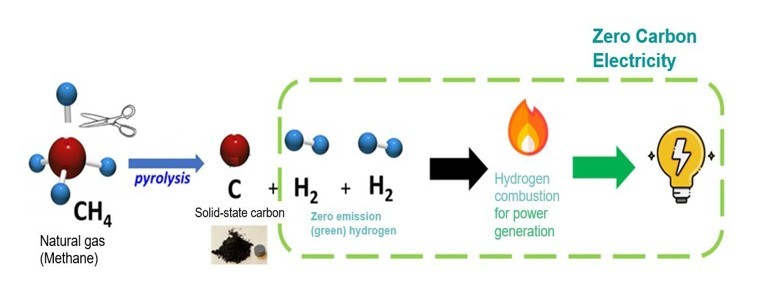
Two possible technologies can help us change conventional gas-fired power generation. The first is carbon capture and storage (CCS), which captures the carbon dioxide produced during the gas-burning process and stores it in carbon sequestration sites. This approach can reduce carbon emissions; however, identifying suitable carbon sequestration sites in Taiwan may be challenging, and the amount of carbon to be stored remains unknown. Therefore, there is a high degree of uncertainty with this technology. Another possible technology is methane pyrolysis (Methane Pyrolysis to Power, MPTP), which cracks natural gas hydrogen and solid-state carbon, utilizing the hydrogen for combustion to generate electricity, thereby addressing the carbon emission issue associated with natural gas power generation. Academia Sinica is hence actively developing MPTP technology, hoping to meet the dual goals of stable power supply and net-zero carbon emissions.
[1] Since 2000, thermal power generation has accounted for 75%-80% of total power generation in Taiwan. After 2015, as the proportion of nuclear power dropped from 16% to 14% and continued to decline, thermal power generation has consistently accounted for 80% of total power generation over the past decade.
● Power generated by MPTP does not emit carbon dioxide and can be used as a baseload power:
MPTP obtains hydrogen by cracking natural gas (methane) and the hydrogen generated is burned in a gas turbine unit to generate electricity, which can be used as baseload power. The process does not emit carbon dioxide. Solid-state carbon produced after the cracking process can be stored or utilized separately.
● MPTP technology can work well with hydrogen-enriched natural gas (HENG) for power generation, as well as pure hydrogen for power generation.
Technologies for pure hydrogen combustion for power generation, as well as those for mass production of low-carbon hydrogen, are not yet mature. Hence, the initial application of hydrogen for power generation mainly involves burning a low proportion of HENG in existing gas generators. With minimal adjustments to the infrastructure (and using 10% to 20% HENG with existing gas generators), we can start to use hydrogen for power generation and reduce carbon emissions. As MPTP technology can adjust the amount of hydrogen and natural gas to be produced (e.g., 20% hydrogen-enriched natural gas), it works well with HENG power generation. Once the technology for pure hydrogen-fueled gas turbine burners matures, MPTP technology can be used to provide pure hydrogen for pure-hydrogen power generation.
● MPTP does not need to build infrastructure for the transportation and storage of hydrogen
It is expensive to transport and store hydrogen, which is why hydrogen transportation and storage present significant technical challenges for using hydrogen in power generation. MPTP technology is designed to transport the natural gas originally intended for use in gas-fired power plants to the methane pyrolysis facilities within the plant for hydrogen production. The produced hydrogen is then delivered straight to the gas generator set for combustion and power generation. This design enables on-demand production and use, so no hydrogen needs to be transported and stored. Thus, it can be applied to gas-fired power plants.
● MPTP technology is a good option for Taiwan to produce low-carbon hydrogen.
Although hydrogen energy does not emit carbon, 99% of the world's hydrogen is produced through methods that will result in carbon emissions (known as brown hydrogen or gray hydrogen). If the goal is to achieve the net-zero emission target using hydrogen energy, it is necessary to develop low-carbon and zero-carbon hydrogen technologies, and methane pyrolysis used in MPTP technology to generate hydrogen is a relatively low-carbon technology.
● Carbon reduction
If MPTP technology is successfully applied to Taiwan's gas-fired power generation systems, it would significantly reduce our carbon emissions. At present, natural gas power generation in Taiwan produces approximately 120 billion kWh/year, with a theoretical carbon emission of approximately 43 million metric tons/year. If we produce the same amount of electricity using a 20% HENG plus MPTP technology, the theoretical carbon emission would be reduced to 41.5 million metric tons/year. In other words, we can reduce our carbon emissions by 1.5 million metric tons/year (3.5% of emissions from gas-fired power generation).
Source: The research team, Academia Sinica
MPTP is a low-carbon hydrogen production technology that has attracted considerable international attention. Existing low- and zero-carbon hydrogen production technologies include green hydrogen, blue hydrogen, and green-blue hydrogen (methane pyrolysis). However, as shown in Figure 2, methane pyrolysis for hydrogen production is a technology that can produce more net energy. Since the supply of green power in Taiwan remains insufficient to meet demand, there is no room to utilize green energy to produce green hydrogen. As for blue hydrogen, challenges of suitable carbon sequestration sites still need to be overcome. It can thus be concluded that MPTP is a good option for Taiwan to generate low-carbon hydrogen.